What POTS Feels Like (From Someone Living It Every Day)
I’m sitting on the edge of my bed. My feet are on the floor. My eyes are open.
I’m fully awake.
And I cannot stand up yet.
Not because I don’t want to. Because if I do, my heart rate will spike from 70 to 130 inside of about ten seconds, the room will narrow at the edges, my hands and feet will turn a strange purple, and I’ll have to sit back down anyway. So I wait. A minute, sometimes longer. I drink water and flex my calves. I let my body figure out what every other body figures out automatically the second it changes position.
This is what POTS feels like, and most of what’s written about it online won’t tell you that part.
Postural Orthostatic Tachycardia Syndrome has a definition, diagnostic criteria, and a tilt-table test. I covered all of that in an earlier post about dysautonomia. What I want to write about here is different. This is what it actually feels like to live in a body that has POTS, every day, in the small, ordinary moments that no one else sees.
A quick definition, for context
If you’re brand new to POTS, here’s the shortest, honest version: it’s a condition where your autonomic nervous system — the part that handles things you shouldn’t have to think about, like heart rate and blood pressure — doesn’t properly manage the transition from lying down to standing up. Your heart races to compensate. Blood pools in your legs. Your brain doesn’t get enough of what it needs. For a deeper overview, Dysautonomia International has excellent resources for patients and families.
That’s the medical explanation. I went deeper into it in my dysautonomia post, and if you want the full picture of what POTS is and how it relates to other autonomic conditions, that’s the place to start.
This post is about something different. This post is about what it feels like in the body. The daily reality. The part you only learn from living it.
What POTS feels like first thing in the morning
Mornings are usually the hardest window.
Overnight, your body has been horizontal for hours. Your blood volume has shifted. The first time you go vertical — sitting up, then standing — is when POTS lets you know it’s still here.
The moment I sit up in bed, I can feel my heart pick up. Not a normal heartbeat. A specific kind of pounding that lives in my throat and my temples at the same time. If I stand up too fast, I get a wave of dizziness that arrives a few seconds after I’m already upright — which is the dangerous part, because by the time the dizziness lands, I’m already committed to being on my feet.
Mornings are a whole new system now. I don’t stand right away — I perch on the edge of the bed and let my body catch up. I drink the water I keep by the bed, flex my legs to get things moving, and ease into the day instead of blasting into it. If I rush those first thirty minutes, the rest of the day pays for it.
None of this is dramatic. It’s just the new normal of getting up in the morning.
The daily reality nobody warns you about
Here’s the thing about POTS that surprised me most after diagnosis: it doesn’t politely confine itself to the moments I’m standing.
Yes, the symptoms are worst when I’m upright. But the consequences ripple through the whole day. The brain fog that follows a bad standing episode can linger for hours. The fatigue isn’t just “I’m tired” — it’s a specific, leaden kind of exhaustion that makes thinking feel like wading through water.
Eating a meal can trigger symptoms because digestion pulls blood toward the gut and away from where it’s needed elsewhere. A hot day will wreck me before I’ve stepped outside, because heat causes blood vessels to dilate, which makes the pooling worse. A cold I’d have shaken off in three days before POTS now takes two weeks and leaves me flattened. My period makes everything worse. Stress makes everything worse. A poor night’s sleep makes everything worse.
And it’s unpredictable. Two mornings that look identical from the outside can produce wildly different days. I can do everything “right” — hydration, salt, compression, slow transitions — and still have a day where my body simply will not cooperate. There’s no formula. There’s only the ongoing negotiation.
What does POTS feel like to live with, day to day?
This is the question I wish someone had answered for me before I had to figure it out myself.
Living with POTS day to day means doing math constantly. Every activity has a cost, and the budget resets unpredictably. Going to one medical appointment can take two days of recovery. A shower can take an hour out of my afternoon. A trip to the grocery store — back when that was still on the table — used to require planning, pacing, and a recovery window on the other side.
The hardest part isn’t the symptoms. The hardest part is that the symptoms are invisible to everyone else.
People look at me and see someone who looks fine. Sometimes they tell me so, and they mean it as a compliment. “You look great today” lands differently when your body is in active revolt and you’re using everything you have to hold a conversation upright. I’m not offended by it — they don’t know. They can’t know. POTS doesn’t come with a visible cast or a cane or a hospital bracelet. It comes with a body that’s doing extraordinary work to perform the appearance of normal.
A “good day” with POTS isn’t a day without symptoms. It’s a day where I have enough capacity to do one or two meaningful things before I need to lie down. A bad day is a day where lying down is most of what I do. The gap between those two states can be small enough that no one else notices, and large enough that it changes everything about my life.
The exhaustion that doesn’t show on a tilt table test
Here’s what clinical sites can’t tell you, because clinical sites measure what’s measurable: POTS doesn’t end when your heart rate normalizes.
After a flare — which can be triggered by something as small as standing in line at a pharmacy — the recovery isn’t a few minutes of sitting down. It’s hours. Sometimes days. There’s a specific kind of post-exertional crash that arrives several hours after the trigger, when you thought you’d already paid the cost. You haven’t. The bill comes due later, and it’s bigger than you thought.
This is the part of POTS that wrecks lives quietly. You can push through a single moment of standing in a store. What you can’t do is avoid the consequences — your body will make you suffer them for the next thirty-six hours.
This is also why “but you did that thing yesterday” is one of the most exhausting sentences in chronic illness. Yes. I did. And today is the bill for yesterday. The fact that I was vertical at a family event on Saturday is exactly why I’m horizontal on Monday. It’s not a contradiction. It’s a consequence.
The tilt table test catches the cardiovascular mechanism. It does not catch the ongoing daily cost of having that mechanism break down constantly, in ordinary moments, for the rest of your life. The disability of POTS lives in that gap.
So what do you do with a body like this?
What helps (and what’s just survival)
There is no cure for POTS. What there is, instead, is a small toolkit of strategies that make the daily reality more manageable. Some of these are medical. Most are practical. None of them fix it.
The basics that most people with POTS rely on, in some combination:
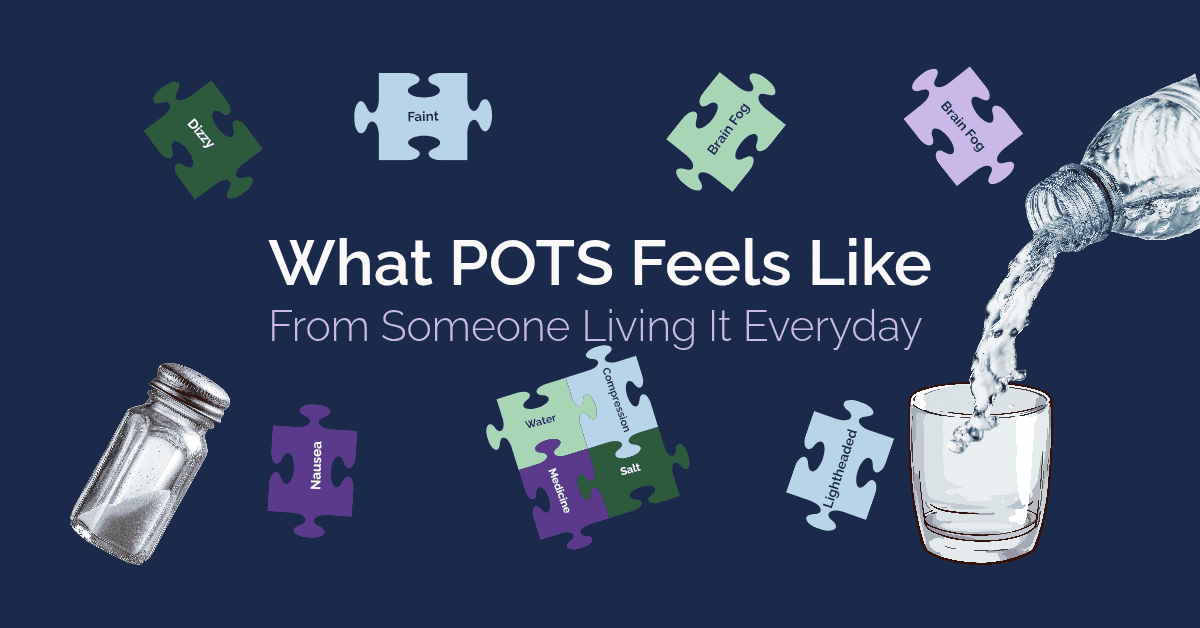
- Hydration, far above what you’d think is normal. Two to three liters of water a day, often with electrolytes added, because plain water alone doesn’t hold in a body with low blood volume.
- Salt, also far above what you’d think is normal. Salt helps your body retain fluid. Most POTS patients are told to dramatically increase sodium intake, often through salt tablets or electrolyte mixes.
- Compression. Compression socks, compression leggings, compression abdominal binders. The point is to physically prevent blood from pooling in the lower body. Some people swear by them, others find them brutal in summer. I use them selectively.
- Slowing every transition. From lying to sitting, sitting to standing, and standing to walking. The slower the transition, the less violent the response.
- Lying down without apology. This is the survival piece. When my body says no more upright, it means it. Fighting that signal makes everything worse. The chronic illness world is full of people who learned this the hard way, including me.
I have a list of specific products I personally use for these — compression, electrolytes, the cooling tools that help on hot days, and a few small things that have made a disproportionate difference. I’ll be sharing those in a more detailed post soon, with honest reviews. (Some of those will include affiliate links, fully disclosed, because that’s part of how this blog stays sustainable.)
For now, the most important thing I can tell you is this: the goal isn’t to feel normal. The goal is to manage the cost of being upright in a body that doesn’t manage it for you.
What I wish people understood about POTS
What I wish people understood about POTS is that the symptoms often look like other things, but they aren’t. My body can slow to a crawl, but that isn’t laziness. Often, my mind can go cloudy, but that isn’t confusion or lack of effort. My heart can race like I’m panicking, but it isn’t anxiety. My legs can feel heavy and unsteady, but that isn’t weakness. All of these are the downstream effects of one problem: a malfunction in my autonomic nervous system — the system that’s supposed to run the basics of being alive without me having to think about it. When that system misfires, everything else in my life feels the impact.
The most loving thing anyone has done for me is simply to believe me. I don’t need them to try and fix the unfixable or suggest miracle cures for my incurable condition. I don’t want to be compared me to someone’s cousin who tried lemon water. Just trust that what I’m describing is what I’m living. That kind of belief is something every person with POTS deserves.
This is what POTS feels like. This is what daily life looks like inside it. And part of why I’m building this blog is so the next person searching “what does POTS feel like” finds someone willing to tell the truth.
💜 Lyn