Why Support Matters When Chronic Illness Shrinks Your World (Understanding the Deep Impact of Chronic Illness Grief)
When chronic illness enters your life, it doesn’t always arrive with a dramatic collapse. Sometimes it slips in quietly, rearranging everything before you even realize what’s happening. One day your life feels full and familiar — and then, slowly, without your consent, your world begins to shrink from chronic illness grief.
Not all at once. Not loudly. But steadily.
And with that shrinking comes chronic illness grief. Real grief. The kind you would never expect, and the kind most people never notice. It’s the beginning of grieving the life you lost to chronic illness, even if you don’t have the words for it yet.
“I’m Just Not a Group Person.”
When one of my doctors first suggested I join a support group, I had a whole list of reasons it wasn’t for me. I was doing “fine.” I didn’t want to sit in a circle, virtual or physical, and talk about my feelings with strangers. I’m not a group person. I already had enough appointments. I’d be okay.
So I avoided it.
Until I ran out of excuses to tell my doctor. And myself.
The Quietness of Chronic Illness Grief
Here’s what nobody tells you when you get a chronic diagnosis: you’re going to grieve.
Not the way you would mourne a death exactly, but a quieter, stranger grief that usually happens alone.
You grieve the body you used to trust. The version of your life you pictured. The plans that quietly became impossible. The person you were before “managing your condition” became your full‑time job.
Once I actually allowed myself to think about it, the more I realized how many life-changing emotional losses of chronic illness had piled up. Chronic illness grief is rarely a singular loss.
The Emotional Losses of Chronic Illness I Experienced
Sense of Self
Chronic illness slowly erodes the identity you once recognized. You go from being the person who could push through anything to the person who has to calculate every step.
Before illness, your identity was shaped by what you could do — your reliability, your energy, your competence, your independence. It wasn’t just what you did; it was how you saw yourself. When those abilities shift, the identity built on them starts to crack. You’re still you, but the scaffolding that held your sense of self together has changed.
And it shows up in the smallest, most ordinary ways. You used to move through the world with ease. You used to trust your body. Now you find yourself needing help with things you once did without thinking — carrying groceries, climbing stairs, standing in line, cooking, even just existing in a body that no longer cooperates. Every time you have to ask, a small part of you whispers, I used to be able to do this.
That whisper is grief.
Independence
Independence loss hits your routines, your identity, and your confidence all at once. Suddenly you’re asking for help with things you used to do without thinking. You’re negotiating every outing. You’re grieving the freedom of moving through the world on your own terms.
Driving is where this one cut deepest for me. [your real moment here — when you realized driving wasn’t a given anymore] It isn’t just transportation — it’s autonomy, privacy, the ability to leave when you need to. Losing it to dizziness, pain, or unpredictability shrinks your world in ways most people never see, because they’ve never had to think about it.
Connection
Friendship loss is often the first heartbreak of chronic illness — the one that hits before you even have language for what’s happening. It doesn’t explode; it erodes. It’s the slow, painful realization that the people who once filled your life with ease and laughter now feel farther away, even if nothing “big” happened.
Before illness, connection was built on shared pace, shared spontaneity, shared energy. You could show up. You could stay out late. You could say yes without calculating the cost.
But it isn’t only the close friendships. It’s the everyday touchpoints, too — the coworker you chatted with every morning, the barista who knew your order, the neighbors you waved at, the book club, the volunteer group. They weren’t always deep relationships, but they were anchors. They stitched your days together. Chronic illness quietly cuts those threads, and people assume you’re uninterested when the truth is you’re exhausted.
Sometimes the losses that look “small” from the outside are the ones that shrink your world the most.
Purpose
Purpose is usually tied to doing — working, contributing, showing up. Before illness, it was woven into the structure of your life so completely you never had to think about it. Then chronic illness strips that structure away. Suddenly your days revolve around symptoms, appointments, pacing, and recovery, and the things that once gave your life shape become unpredictable or impossible.
For me, one of the bitterest pills to swallow was needing to leave my job at MIT. I had finally found a job I loved, with an organization that truly respects and values their employees. I was happy there. But the symptoms that I’d been dealing with for several years were getting more difficult to manage. I thought I was losing my mind. I couldn’t keep making random excuses when I couldn’t function enough to go to work. After talking with my doctor, it was clear I needed to go out on leave. Leaving a job you love is like losing a version of yourself. It’s losing purpose, structure, community, and momentum all at once. Chronic illness doesn’t just interrupt a career — it interrupts a story you were still writing. And when the work falls away, so do the communities and connections that came with it.
Fertility
Loss of fertility is one of the most intimate and misunderstood forms of chronic illness grief. It’s not just about children or motherhood — it’s about losing a biological possibility you always assumed would be there. It’s the grief of a door closing inside your own body, often quietly, often without warning, often before you’re ready.
Fertility is something most people grow up taking for granted. You don’t think about it until you have to. You assume your body will cooperate when the time comes. That you’ll have choices and get to decide. Chronic illness steals that illusion.
Because fertility is so deeply tied to identity, womanhood and adulthood, this loss can feel isolating. People don’t know what to say. Some minimize it. Some avoid it. Some assume you “never wanted kids anyway.” Some treat it like a footnote instead of a painful fracture.
Pride
Hand-in-hand with all of these is the loss of pride — your sense of capability, your reliability, your self-trust, your old standards for yourself. Chronic illness forces you to renegotiate what pride even means. It asks you to build a new identity in a body that doesn’t behave the way it used to, and that rebuilding is hard, humbling, and vulnerable.
But here’s the truth that matters: your worth was never in your productivity. Your value was never in your stamina. Your pride doesn’t have to disappear — it just has to evolve.
There is pride in surviving, adapting, and listening to your body instead of fighting it. There is pride in asking for help when you need it and continuing to show up in whatever way you can.
Losing the old version of pride doesn’t mean you’ve lost yourself. It means you’re becoming someone new — someone softer, wiser, and far more honest than the world ever taught you to be.
How Chronic Illness Shrinks Your World and Why Support is Essential
Chronic illness doesn’t just take things away. It takes away the version of you who could navigate life without thinking about symptoms, energy, or risk.
- Your world gets smaller.
- Your options get narrower.
- Your independence gets chipped away.
And this is exactly where support becomes not just helpful — but essential.
Support isn’t about being “sick enough.” It’s about being human in a life that has become too heavy to carry alone.
- You deserve steadiness.
- You deserve tools.
- You deserve connection.
- You deserve relief.
- You deserve people who understand the language your body now speaks.
Here’s what matters: you don’t have to carry these losses alone. And support isn’t a single path — it’s a landscape. There is no single, daunting room you are forced to walk into. There are different kinds of help for different needs, and the trick isn’t forcing yourself into the first option—it’s finding the one that actually fits where you are.
Once I stopped avoiding support, I realized there were options I didn’t even know existed, with each one meeting a different need.
The Map I Followed
A Therapeutic Group (For Connection and Coping)
- The Program: Living with Persistent Medical Symptoms and Pain (Mass General Brigham, Department of Psychiatry).
- What it is: This is an open-ended mixed adult group that strikes a beautiful balance between interpersonal support and practical coping strategies. It focuses heavily on acceptance, communication, and navigating the daily psychological toll of illness.
- My experience: This was the exact program I resisted the hardest, and the one that completely changed my mind about being “a group person”. What surprised me most was the profound relief of being in a virtual room with people who just got it—where I didn’t have to spend my limited energy explaining my symptoms because everyone already understood.
The Interdisciplinary Pain Program (For Whole-Body Rehabilitation)
- The Program: Pain and Functional Restoration Program at (Spaulding Rehabilitation Hospital).
- What it is: This program treats chronic pain using a comprehensive, team-based approach. Crucially, it includes a robust behavioral health (BH) component featuring cognitive behavioral therapy (CBT), meditation, relaxation techniques, supportive counseling, and family education.
- My experience: I actually attended this program twice: the first time virtually during COVID at my neurologist’s suggestion, and the second time in person at my own request. The behavioral health component was a game-changer for me. It provided concrete coping tools and offered the validation that pain isn’t just physical—it impacts every single layer of your life.
- Worth knowing: Programs like this typically require a formal doctor’s referral, so it’s a conversation worth having with your care team.
Mind-Body Resilience Training (For Stress Reduction)
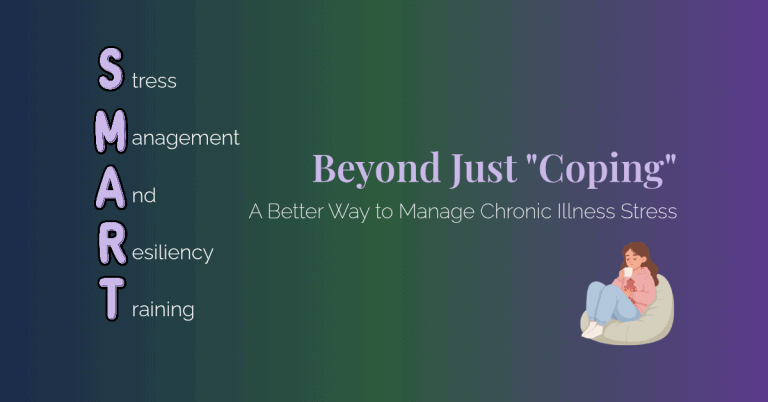
- The Program: SMART (Stress Management and Resiliency Training) (Mass General Brigham’s Benson-Henry Institute for Mind/Body Medicine).
- What it is: I’ve written extensively about this before (read about it here), but it bears repeating. This program focuses heavily on the physiological relaxation response. It is less about “talking about your feelings” and more about giving you concrete, evidence-based tools to manage the relationship between stress and a body that is already struggling.
- My Experience: I was able to attend the whole program virtually and on a 1:1 basis with one of the directors. I would like to attend again some day in the original, in-person group format.
- Bonus: It was entirely covered by my insurance.
Free, Virtual, and Built for Disability (For Accessible Wellness)
- The Program: MENTOR (8-week) and GROWTH (6-week mental wellness) (NCHPAD—National Center on Health, Physical Activity and Disability).
- What it is: Discovered via a recommendation from Spaulding, these programs focus on mindfulness, exercise, nutrition, and resilience. They are completely free, entirely virtual, and designed from the ground up specifically for people living with disabilities and mobility limitations. The coolest thing about the MENTOR Program is every group member receives a giant package in the mail prior to the start of the group. The package contains exercise equipment and gear to get you started. You can sign-up for NCHPAD Connect here.
- My experience: On the days when I am housebound and leaving the living room feels like a mountain to climb, the “from home” aspect of this support is everything. If leaving the house is your primary barrier to getting help, programs like these exist precisely for that reason.
- Bonus: After you’ve attended a group through NCHPAD, they remain in contact and invested in your health and well-being. You continue to have access to NCHPAD Connect, a free, online community offering health promotion programs, resources, and virtual events for adults with mobility limitations. You have continuous access to the app, where all the tools, handouts and slides from your groups are stored. They have an active Facebook page and an ongoing, virtual, bi-monthly Coffee Club.
Give Yourself Permission
I joined that first support group convinced I didn’t belong there. I thought I was handling things okay and I wanted no part of joining a group.
But here’s what I didn’t understand then — and what I want you to hear now:
- Support isn’t for people who are failing.
- Support is for people who have been carrying too much, for too long, mostly alone.
- You don’t have to justify your pain.
- You don’t have to wait until your life is unrecognizable.
- You don’t have to break before you’re allowed to be held.
If you’ve been waiting for a sign, a permission slip, a reason to reach for support… this is it.
You don’t have to carry this alone anymore.
You never should have had to in the first place.
With salt, spoons, and solidarity,
Lyn 💜