Salt, Spoons, and Syncope · Chronic Illness Life, Written Honestly
If you found this page, there’s a good chance something brought you here that you’d rather not have needed. Maybe you just got a diagnosis that took years to get — and now that you finally have a name for it, you’re not sure whether to cry or celebrate. Maybe you’re still in the middle of the diagnostic maze, collecting symptoms like terrible souvenirs while doctors shrug and tell you your labs look fine. Or maybe you’ve been doing this for a while and you’re just tired, and you needed to find someone who wouldn’t immediately tell you to try yoga. Whatever brought you here — you’re welcome, exactly as you are.
This blog is called Salt, Spoons, and Syncope, and the name isn’t an accident. Salt because those of us with POTS (Postural Orthostatic Tachycardia Syndrome) are often prescribed high sodium intake — it’s one of the stranger facts of our daily life, and it felt like the right kind of absurd detail to lead with. Spoons is a nod to Spoon Theory, the now-beloved framework coined by Christine Miserandino that uses spoons as a metaphor for the finite, unpredictable units of energy that people with chronic illness have to spend each day. And syncope — well, that’s just the medical word for fainting or nearly fainting, which is, unfortunately, a very real and very inconvenient part of life with dysautonomia. Together, those three words felt like an honest little summary of what this life actually looks like.
I’m Lyn. I started this blog because I needed it and it didn’t exist yet. What you’ll find here isn’t medical advice or relentless positivity. It’s real writing about a real life — the frustrating parts, the funny parts, the parts that are both at once. I hope it feels like sitting across from someone who already knows what you’re going to say, and is nodding before you finish the sentence.
My Story (The Short Version)
I have POTS — Postural Orthostatic Tachycardia Syndrome — and the broader umbrella condition it lives under, dysautonomia. What that means in practice is that my autonomic nervous system, the part that’s supposed to quietly handle things like heart rate, blood pressure, digestion, and temperature regulation without any input from me, doesn’t do its job reliably. Standing up becomes a whole event. Heat is a hazard. My heart races when I go from sitting to standing. I pass out, or come close to it, more than anyone would like. My body requires a level of management and negotiation that most people reserve for difficult coworkers.
Getting here took years. Years of being told I was anxious, or deconditioned, or that I just needed to drink more water. Years of symptoms that were very real and very present while the paperwork kept saying nothing was wrong. The road to a POTS diagnosis is notoriously long — the average is around five to six years — and it reshapes you in ways you don’t fully understand until you’re on the other side. Not just physically. The way you see yourself, the way you relate to your body, the way you navigate relationships and work and the world — all of it shifts. Some of it is loss. Some of it, unexpectedly, is not.
I started this blog because I kept wanting a place that was honest about all of it — not just the coping strategies, but the grief. Not just the bad days, but the dark humor that makes the bad days survivable. If you want the full story — the diagnosis, the disbelief, and everything that led me here — you can read it in Who I Am and Why This Blog Exists. That’s the post where I didn’t hold very much back.
What You’ll Find Here
This isn’t a one-topic blog, because chronic illness isn’t a one-topic life. It touches everything — your body, your mind, your relationships, your sense of who you are. So the writing here tries to keep up with that. Here’s what you can expect to find:
- POTS & Dysautonomia — What it is, what it actually feels like to live inside it, and how to manage it when the medical system has handed you a diagnosis and not much else.
- The Diagnostic Journey — Navigating a system that wasn’t really built for people like us. Building your paper trail. Learning to advocate for yourself when advocating is the last thing you have energy for.
- Practical Survival — Real tools, real gear, real strategies. The stuff that actually helps, sourced from someone who has tried a lot of things that didn’t.
- The Emotional Reality — The grief, the isolation, the identity shifts that nobody warns you about. And the dark humor that threads through all of it, keeping things livable.
- Symptom Reality Checks — Honest writing about what chronic illness actually looks and feels like from the inside. Because sometimes you just need someone to describe your life back to you accurately.
- Community & Connection — You are not alone in this. This space exists, in part, as proof of that.No matter where you are in your journey — newly diagnosed, years in, or still searching for answers — there’s something here for you. You don’t have to be at any particular stage to belong in this space.
New Here? Start With These
These posts are the best place to begin — they’re the foundation of everything else on this site. If you’re not sure where to start, start here, in order or out of it. There’s no wrong way in.
When Everything Gets Louder: Managing Chronic Illness Flares and Ways to Move Through Them
Beyond “Just Coping”: A Better Way to Manage Chronic Illness Stress
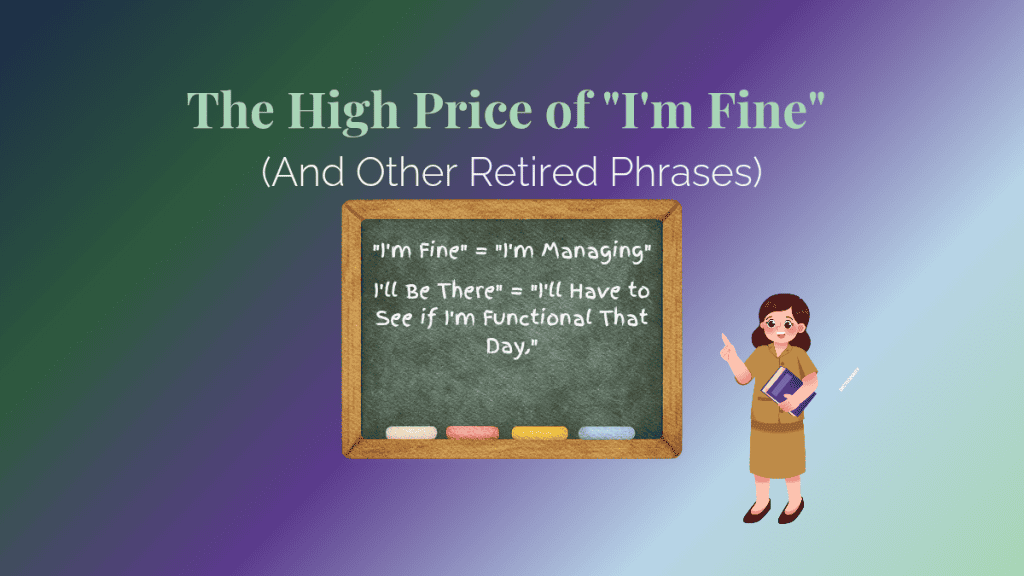
The High Price of “I’m Fine” (and Other Retired Phrases in the Chronic Illness Vocabulary)
I Wake Up Missing Spoons
Before You Go
I want to say something directly to you, before you click away into the rest of the site. Chronic illness is exhausting in ways that are hard to explain to people who haven’t lived it — not just physically, but in every other way, too. The uncertainty of not knowing how you’ll feel tomorrow. The grief of the life you had, or the life you thought you’d have. The particular loneliness of being sick in a way that’s invisible, or complicated, or that the people around you keep accidentally minimizing. That’s real. All of it is real, and you are allowed to feel the full weight of it. You don’t have to be brave about it here.
This space is for you on the hard days and the slightly-less-hard ones. It’s for the days when you want practical answers and the days when you just want someone to have said something true. Chronic illness has a way of making a person feel profoundly alone — but one of the small, stubborn mercies I’ve found is that there are so many of us, and we tend to find each other eventually. You found this. That counts. I’m glad you’re here.
With salt, spoons, and solidarity,
— 💜 Lyn