I Wake Up Missing Spoons
Spoon Theory Explained: What It Is and Where It Came From
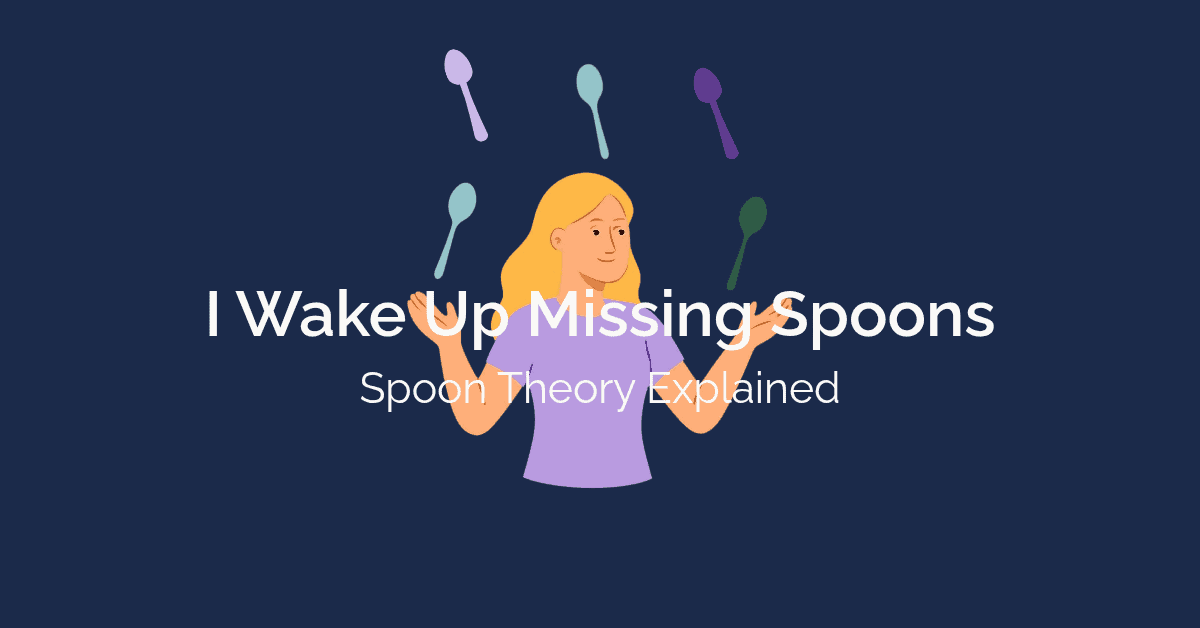
If you’ve spent any time in chronic illness spaces online, you’ve probably come across Spoon Theory. (Read about it here.) It was created by Christine Miserandino, who used spoons at a diner table to explain to a friend what living with lupus actually feels like. The idea is simple: you start each day with a limited number of spoons, and everything you do costs one. Healthy people don’t think about this because they don’t have to — their spoons replenish overnight, and they wake up with a full drawer.
Most Days, I Wake Up Missing Spoons.
Not every day is the same — some are harder, some are marginally better — but “good days” aren’t really part of my vocabulary anymore. I have better days. And on those better days, I’m still starting in the hole.
That’s the part that’s hard to explain to someone who hasn’t lived it. It’s not that I’m tired. Everyone gets tired. It’s that my baseline is a level of exhaustion that most people have only touched on their worst days — and I’m building my entire life on top of it.
It’s Not Just One Thing
I live with several chronic conditions — POTS, Gastroparesis, Small Fiber Neuropathy, among others. (If you’re not sure what POTS feels like from the inside, I wrote about that here.) Some days one is louder than the others. Most of the time, they take turns . Some days I genuinely couldn’t tell you which one is winning because they’ve all shown up and made themselves at home. The point isn’t which condition is responsible — it’s that my body requires negotiation every single day. The point is that my body requires a kind of negotiation every single day that most people never have to think about.
And then there’s the medication layer — because of course there is. Most of the medications that help manage my conditions carry their own tax: fatigue, brain fog, nausea, dizziness. The very things I’m trying to treat are also being caused, at least in part, by the things treating them. It’s a cruel kind of math that doesn’t get talked about enough. You’re not just managing your conditions. You’re managing the side effects of managing your conditions.
And sometimes the stakes are higher than fatigue. An immunosuppressant trial a few years back nearly cost me my kidneys — Acute Kidney Disease brought on by the medication itself, compounded by kidney function that was already compromised from POTS. I came close to needing dialysis. My kidneys are stable now, but the damage is permanent. That’s a whole post for another day — but I mention it here because it’s important to understand: for people with chronic illness, medication isn’t always a straightforward fix. Sometimes it’s its own crisis.
Even eating costs spoons. Doing laundry costs spoons. Existing, at a baseline, costs spoons.
What Getting Ready Means for
Let me walk you through what getting ready looks like for me on a day I have somewhere to be.
First, I rest. Before I’ve done anything. Before the shower, before I’ve gotten undressed, before any of it — I rest. Because I already know what’s coming and I need to protect what I have before I spend it.
The shower itself is its own negotiation. I haven’t stood up in the shower in seven years. The standing alone would be enough to trigger a cascade — but add lifting my arms over my head to wash my hair, add the heat of the water, and standing isn’t just hard, it’s not an option. So I sit. I move slowly, deliberately, even sitting down. What used to take ten minutes now takes closer to thirty.
When I get out, I sit in the bathroom to recover. Just to dry off.
Once I’m dressed, I rest again — thirty minutes to an hour — before I can even think about drying my hair. Then I dry my hair, sitting. Then I rest again.
By the time I’m ready to walk out the door, a significant chunk of my day — and my energy — is already gone. And that’s on a good enough day to leave the house at all.
💡 A Few Ways I Conserve Spoons (Aka: This Is Strategy, Not Laziness)
- Rest before you start, not just after. I rest before my shower, not because I’ve already done something hard, but because I know what’s coming. Preemptive rest is real and it works.
- Sit down for everything you can sit down for. I shower sitting. I dry my hair sitting. I do dishes sitting when I can. Removing the standing doesn’t mean giving up — it means staying in the game longer. (I put together a list of things that actually help if you’re looking for practical tools.)
- Slow down on purpose. Moving slowly isn’t giving in. It’s protecting what you have left. A task that takes ten minutes standing might take twenty sitting and moving carefully — but I’ll still be upright at the end of it.
- Batch and sequence. If I have an appointment, everything else that day gets stripped back. That’s not pessimism, that’s strategy.
- Give yourself permission to call it. Some days, the answer is staying home. That’s not failure. That’s knowing your body. That’s Spoon Theory explained in real life, not as a concept, but as a daily practice.
The Cancellation Text
Spoon Theory explained the energy side of chronic illness — but it doesn’t fully prepare you for the social side.
Let’s talk about canceling.
If you’re a spoonie, you already know this feeling. The text you have to send an hour before — or sometimes ten minutes before — because your body made the decision before you did. The spiral that follows: the apology, the explanation you’re not sure anyone believes, the guilt that lingers long after the plans are gone.
I’ve missed holidays. Not because I didn’t want to be there — but because I was home, alone, sleeping, because there was simply nothing left. No spoons, no reserves, nothing to borrow against. My body had already closed the tab.
Early on, the hardest part wasn’t even the missing. It was the feeling of being a burden — a feeling I put entirely on myself, by the way. Nobody handed it to me. Chronic illness guilt has a way of building itself from the inside, quietly and thoroughly, until canceling a plan feels like a moral failure instead of a medical reality.
It isn’t. It never was.
One thing that helped me more than I expected — finding my people. There is a whole community of spoonies out there, and it is bigger and warmer than you might think. Facebook groups, Instagram accounts, online forums — spaces full of people who cancel plans too, who wake up missing spoons too, who get it without needing it explained. If you’re newly diagnosed and still figuring out what this life looks like, finding your tribe is one of the best things you can do. Search for your condition, search for chronic illness, search for spoonies — you’ll find them. We’re not hard to find. We’ve just been resting.
The Wildcard
And then there’s the wildcard.
Some days it’s not the getting ready that breaks the budget — it’s something that happens before you even get that far. For me, that wildcard is often Gastroparesis. When it flares, all bets are off. Vomiting is exhausting in a way that’s hard to overstate — it doesn’t just cost today’s spoons, it borrows from tomorrow’s. I’ve had days where I never made it out of the house at all, not because I didn’t try, but because my body had already spent everything before I got to the shower.
That’s a whole post for another day — and I’ll write it. But for now, just know: for many spoonies, there’s always a wildcard condition waiting in the wings. The unpredictability is its own kind of exhausting.
Spoon Theory Explained for the People Who Love Us
If you love someone with chronic illness, this is the part I most need you to hear: the cancellation cost them more than it cost you. They didn’t take it lightly. They probably agonized over it. And the last thing they need in that moment is to feel like they’ve let you down on top of everything else their body is already doing to them.
💡If Someone You Love Is a Spoonie, Here’s How You Can Be Supportive
- Learn their window. Every spoonie has a time of day when they have the most to work with — and it’s not the same for everyone. For some it’s morning, for others it’s afternoon. For me, mornings are my best shot — by midday I’m already fading. Ask the spoonie in your life when their window is, and then actually plan around the answer. It makes a bigger difference than you’d think.
- Take cancellations at face value. When we cancel last minute, it’s not about you and it’s not a choice we’re making lightly. The guilt we already feel is enormous. “I hope you feel better soon.” lands a lot softer than silence or frustration.
- Stop asking “are you okay?” We are never fully okay — that’s the whole thing. Try “how are your spoons today?” or “what do you need?” It shows you get it, even a little.
- Don’t compare days. “But you seemed fine yesterday” is one of the hardest things to hear. Yesterday’s better day didn’t mean we were fixed. It meant we had a little more to work with — and we probably spent it.
We’re Still Here, Even If It Feels Like We’re Disappearing
If you’re a spoonie reading this — I see you. The resting before the shower, the sitting in the bathroom after, the texts you’ve had to send, the holidays you’ve slept through. None of it makes you a burden. None of it makes you less. It makes you someone who is doing an extraordinary amount of work that most people will never see, every single day, just to exist in a world that wasn’t built for a body like ours. We’re doing the best we can.
You are not failing at life. You are living a different version of it — and that version is harder than most people will ever understand.
And if you’re someone who loves a spoonie, thank you for reading this far. It means more than you know. We want you to understand that when we cancel plans, rest, or disappear for a while — we’re not choosing that over you. We’re just trying to have enough left to show up for you another day.
That’s Spoon Theory, explained by someone who knows what it’s like to live every day already short on spoons.
💜 Lyn