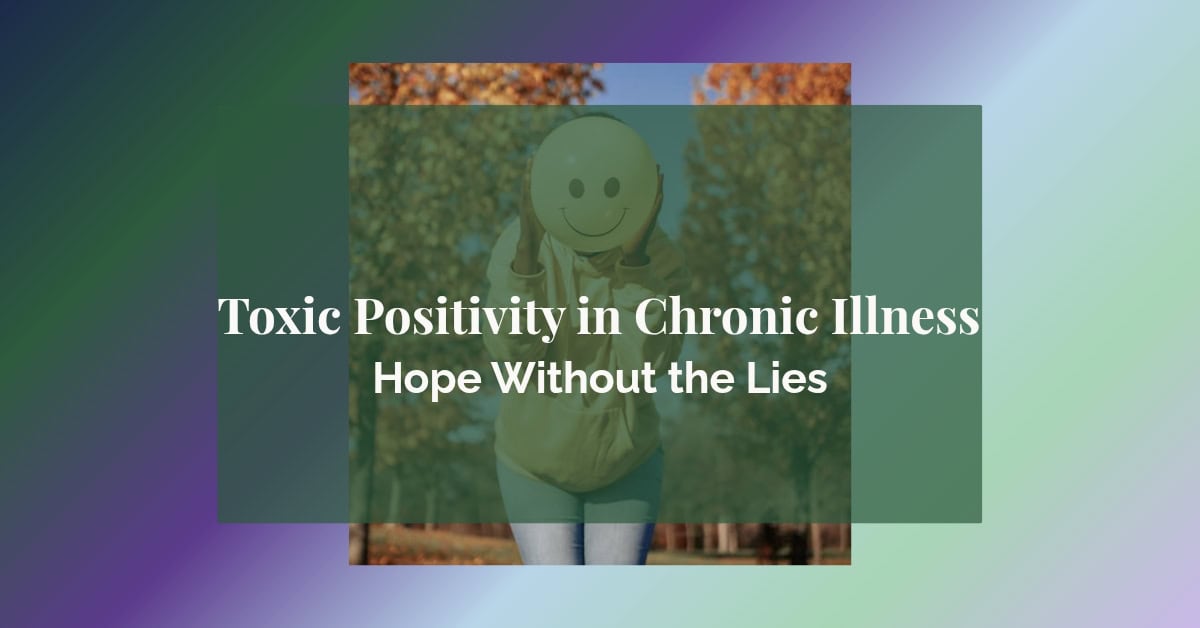
Toxic Positivity in Chronic Illness: Hope Without the Lies
I don’t think I’ll ever be able to capture everything I’ve lived through in the seven years since my diagnosis. I don’t even have the words for what my day‑to‑day looks like now. Well — I do. I just don’t share them. Not really. I do my best to avoid toxic positivity in chronic illness life. I believe in Healthy Optimism.
I’ve learned that letting people in doesn’t help me much. People know I’m sick — usually they’ve never heard of my condition — and they definitely don’t understand what I carry around with me every single day. I hate trying to explain it because it’s complicated, and honestly, half the time I don’t understand it either.
I Wish People Just Understood Sometimes
They don’t have to say “hope you feel better soon” every time they see me. I’m chronically ill in a way that’s layered and permanent. This is my baseline. You should see my flares.
I eventually learned my infertility was tied to my illness, too. A well‑meaning friend told me it might be a blessing, that God works in mysterious ways. Not helpful. Not even close.
That’s the thing about toxic positivity in chronic illness: it almost never arrives as cruelty. It arrives as a gift — bright, shiny, well‑meaning — and somehow leaves you holding all the weight.
The most exhausting kindness there is.
If you’ve been chronically ill for more than a week, you know the genre.
Stay positive.
It could be worse.
Have you tried yoga?
You don’t look sick!
These aren’t insults. They’re usually said by people who love you, or at least care enough to want you to feel better. That’s exactly what makes them so slippery.
Toxic positivity insists you stay upbeat no matter what’s happening in your body or your life. It treats a hard feeling like a problem to solve with the right attitude. And it’s everywhere in the chronic‑illness world, because most people genuinely don’t know what else to say. A real feeling makes them uncomfortable, so they reach for a slogan. The slogan comforts them. You’re left with the leftovers.
The part that took me too long to figure out
The problem was never positivity.
The problem is the word hiding inside the slogan: instead.
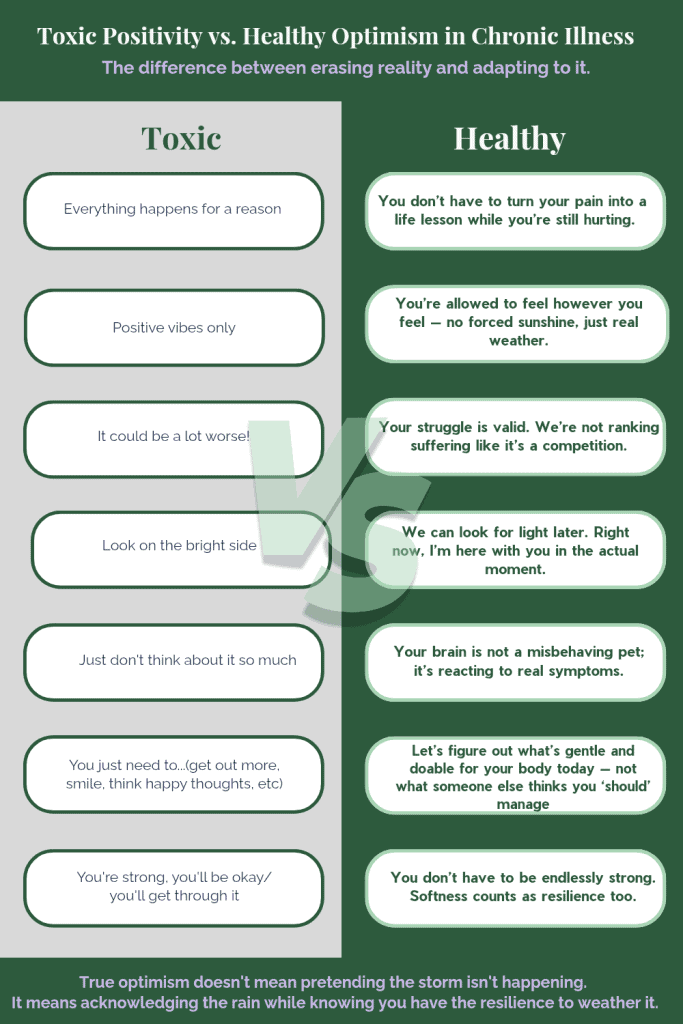
Toxic positivity asks you to be cheerful instead of honest with how you’re feeling.
Healthy optimism lets you be hopeful and honest at the same time.
“It could be worse” deletes.
“This is hard right now — and I’ve gotten through hard before” holds both.
Same situation. One requires a lie. The other doesn’t.
What it sounds like in real life
“Everything happens for a reason” demands meaning on a deadline.
The honest version doesn’t: this doesn’t have to mean anything — and I can still hope tomorrow is gentler.
“Just stay positive!” treats your mood like a light switch you’re refusing to flip.
The honest version knows better: I can have a brutal day and still believe better ones are coming.
“Good vibes only” quietly closes a door.
The honest version keeps it open: every feeling gets a seat. Hope just isn’t the only one.
And “you don’t look sick” — the compliment that isn’t — is best answered with a fact: what I’m carrying is real.
None of the honest versions are gloomy. They’re not the opposite of positivity. They’re just true — with hope intact. Honesty doesn’t kill optimism. It’s the only thing that makes optimism believable.
Why toxic positivity in chronically illness costs so much.
When you’re chronically ill, toxic positivity in chronic illness isn’t just annoying. It’s expensive.
It isolates you and teaches you to pretend you’re okay. It trains you to smile through the fatigue and laugh through the pain so you don’t “bring the mood down.” However, pretending you’re okay can become a full‑time job, and being chronically ill already is an unpaid, unwanted full-time job.
And the cruelest part?
You start doing it to yourself.
Come on, stay positive.
Where I’ve landed
I’m not asking anyone to give up hope. I’m asking us to stop making people lie to earn it.
You’re allowed to have a terrible day and still believe a better one is coming. You’re allowed to grieve what this illness has taken and want good things in the same breath. You don’t have to choose.
Optimism that needs you to lie isn’t optimism.
It’s pressure.
And you’ve already got enough of that. For ideas on relieving stress in chronic illness, start here
💜 Lyn