
What Is Dysautonomia? (Explained by Someone Who Actually Has It)
This post contains affiliate links. If you purchase through them, I earn a small commission at no extra cost to you. I only recommend products I actually use.
It started with a visit to my PCP in 2019. I walked in believing, without a doubt, that I was severely depressed. When I left, I was a newly-minted Spoonie with POTS. I was about to begin a maddening seven-year journey to understand what dysautonomia is and how it had quietly taken over my life.
I had every reason to think I was having a major meltdown. My dad lost his battle with depression in 1988. I was 16 years old, and it was the summer before my senior year. He was only 44 years old. Growing up, nobody talked about it. It was hush-hush, the way things were back then. I carried a lot of that silently for a long time.
So when I began having symptoms — a racing heart, dizziness, exhaustion, nausea, vomiting, fainting, and a dozen other things that didn’t connect — my brain went to the darkest explanation it knew. Maybe this was what severe depression felt like in the body. Maybe my body was wired that way from birth.
I told my primary care doctor I thought I was severely depressed. She listened. Then she checked my blood pressure. She checked it again while I was lying down. And then a third time, while I was standing (for those who don’t know, this is a manual way to check for POTS and mimics the Tilt Table Test used in autonomic labs).
She looked at me and said, “Lyn, I think you have POTS.”
I laughed. “No,” I said. “I don’t do that.”
When my doctor mentioned POTS, I thought she meant something else entirely. I was wrong.
What is dysautonomia, exactly?
Here’s the plain-English version, from someone who has spent seven years explaining it over and over.
Dysautonomia is a condition in which the automatic systems in your body — heart rate, blood pressure, digestion, temperature regulation, and your fight-or-flight response — don’t function as they should. Your body reacts unpredictably or overreacts to completely normal things, making everyday activities much harder than they should be.
Your autonomic nervous system is supposed to handle all of this without your input. Standing up, eating, getting warm — your body should adjust automatically. With dysautonomia, it doesn’t. It misfires, overcorrects, or fails to adjust at all.
The types of dysautonomia you’ll hear about most
Dysautonomia isn’t a single condition — it’s an umbrella term covering more than 15 disorders that affect the autonomic nervous system. It’s also common, not rare, to have more than one form at the same time. That’s my situation.
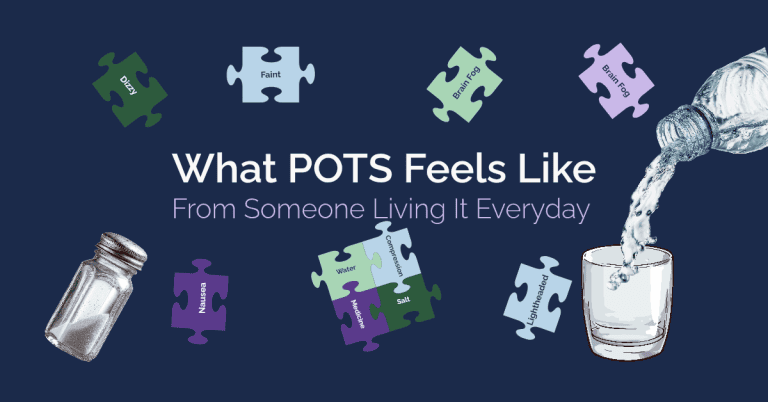
The one most people encounter first is POTS — Postural Orthostatic Tachycardia Syndrome. POTS means that when you change positions — usually when you stand up — your heart rate spikes abnormally. Your blood pressure may drop. Blood pools in your legs instead of circulating properly. Your body is working hard to keep you upright. The diagnostic criteria are a heart rate increase of 30 beats per minute or more within ten minutes of standing, without a significant drop in blood pressure—a simple test. Frequently missed for years.
It’s neurological, not cardiac. This matters because many people with POTS symptoms are sent to cardiologists first and spend months or years being told their heart looks fine. Your heart may be perfectly healthy — mine is. The problem is the system that’s supposed to tell it what to do.
I also have Small Fiber Neuropathy, which falls under the dysautonomia umbrella. SFN affects small nerve fibers that transmit pain signals, temperature sensations, and some autonomic functions. It often goes hand-in-hand with POTS, and that overlap is more common than most people realize.
And I have Neurocardiogenic Syncope, which means my body sometimes just decides to faint, not dramatically, not always with warning. The system glitches, blood pressure drops, and the lights go out.
Other forms include Multiple System Atrophy and Pure Autonomic Failure. All of them are underdiagnosed and frequently misunderstood.
What nobody told me it would actually mean
This is the part that often gets left out at diagnosis. How do we live in a body that doesn’t follow the rules?.
It means that standing up is a calculation. That a shower requires planning — and usually recovery afterward. That heat is your enemy, and so is the cold, because your body can’t regulate temperature the way it’s supposed to. That eating a full meal can send you to the couch for two hours. That your resting heart rate looks like someone who is running a marathon.
It means explaining — again — why you can’t just push through it, why you canceled, and why you were fine yesterday but aren’t today. Why you don’t look sick, but feel like poo. I wrote a whole post about the things people say to chronically ill people and what we actually hear, if you would like to learn more.
It means grieving the version of yourself who didn’t have to think about any of this. I was a senior administrative assistant — dependable, organized, the person people came to when things needed to get done. Thanks to brain fog, I can’t remember where I put things or what day it is. I never saw this coming.
Nobody warns you that a diagnosis — even the correct one, even one you fought years to get — comes with its own kind of loss.
The downstream effects nobody mentions
Here’s something that you might not know: this isn’t just about symptoms. For some of us, the dysregulation causes real damage over time.
POTS affects blood flow. Chronically poor circulation doesn’t just make you dizzy. In my case, it contributed to Chronic Kidney Disease, currently stable at stage 3. I also deal with chronic edema that has lasted over a year. My legs and body retain fluid because the circulatory system isn’t functioning properly. And Small Fiber Neuropathy doesn’t just cause pain and numbness in your feet. It also causes damage to the small nerves in your organs, My dysautonomia is multi-systemic, impacting all of my body’s systems.
I’m not sharing this to scare anyone — I’m sharing it because I wish someone had told me. Dysautonomia isn’t just “feeling dizzy when you stand up.” Untreated or poorly managed, it can have consequences far beyond the nervous system. That is why getting the correct diagnosis early on is important. More importantly, this is why being believed matters.
Why dysautonomia takes so long to diagnose
- Symptoms are often overlooked or mistaken for other conditions
- Many doctors have limited training in autonomic disorders
- Standard tests often come back normal
- Patients, especially women, are frequently told it’s stress
It’s also important to know that not every neurologist specializes in autonomic dysfunction — and honestly, most providers don’t. Dysautonomia sits in this strange medical gap where neurology, cardiology, gastroenterology, and all the other “-ologies” each see pieces of the puzzle, but very few are trained to see the whole picture.
I went through five different GI specialists before anyone realized my symptoms weren’t “just stress” or “just IBS.” It wasn’t until I finally saw a neuro‑GI that I was diagnosed with gastroparesis.
One GI even tried to tell me my GI issues were because of vertigo.
Sure. Okay. 😄
This is why so many of us spend years bouncing between specialists, collecting misdiagnoses, and being told to drink more water or “reduce stress.” Autonomic disorders simply aren’t well covered in most medical training — which is exactly why self‑advocacy (and the right referrals) matter so much.
I spent years being told my symptoms were in my head. I was handed antidepressants. Dismissed by neurologists. Told to exercise more, stress less, and drink more water.
(The water part was actually correct. But that’s not the point.)
What actually helps with dysautonomia
There’s no cure for dysautonomia. But there are many great tools and communities out there that make daily life more manageable.
- Dysautonomia International — the leading nonprofit for dysautonomia research, advocacy, and support. Their website is one of the most reliable places to start learning, and they have a worldwide community of members, including state-level chapters. I’m a member of both the main organization and the Massachusetts chapter.
- The Dysautonomia Project, Second Edition— one of the best resources I’ve found for patients, families, and providers.
- Withings BPM Connect — tracks lying and standing blood pressure and syncs to an app, exactly what you need for orthostatic checks.
- Thigh-high graduated compression socks (20-30 mmHg) — non-negotiable for me personally. They reduce blood pooling and make standing and walking more manageable.
If you just got diagnosed
First: you’re not losing your mind.
Second: find a doctor who truly understands autonomic disorders. Not every neurologist does, and many providers don’t. You may need to advocate for yourself to get the referrals you deserve.
Third: connect with others. Dysautonomia International is a great place to start — their community is real, active, and full of people who have been exactly where you are. If there’s a chapter near you, even better.
And if you went to your doctor thinking you were depressed, only to find out your nervous system had been staging a quiet rebellion for years:
Hi. You found the right place.
💜 Lyn
This post contains affiliate links. If you purchase through them, I earn a small commission at no extra cost to you. I only recommend products I actually use.