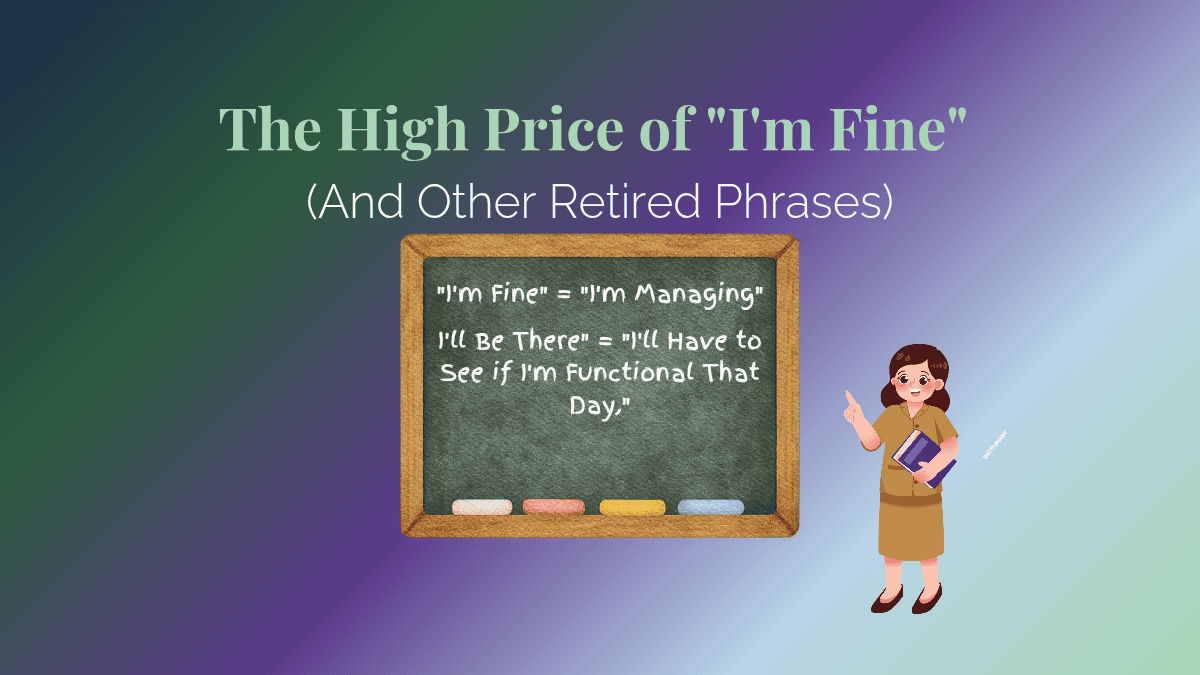
The High Price of “I’m Fine” (and Other Retired Phrases in the Chronic Illness Vocabulary)
Chronic illness will quietly uninstall half your vocabulary. One day you’re saying “I’m fine,” and the next you’re whispering “my joints sound like bubble wrap” into the void while Googling whether that’s normal. (It is. Mostly.)
My body runs on sheer determination and a spoon budget that’s just barely making ends meet. (Read about the Spoon Theory here and here,) At some point, I realized that the words I’d been using didn’t fit my new normal. They were actively working against me.
So, here’s the retirement party nobody threw.
The 11 phrases I finally let go of and the ones that fit my life now
- “Give me a minute to jump in the shower, and then we can go.” Retired because: Nothing is quick anymore. A shower is now a big production with a briefing, a recovery window, and a debrief. “We can go” assumes I have not already spent half my spoons shaving my legs. Now: “Showering is the activity. Going somewhere is optional.”
- “I’ll be there.” Retired because: I was the person who showed up when expected. I was reliable and consistent. Chronic illness took away the person I used to be, Before I was even ready to say goodbye to her Now: “I have to see if I’m functional that day.”
- “I’m fine.” Retired because: I was held together by denial, compression socks, and my one last good nerve. “Fine” was doing a lot of heavy lifting for a word that technically means nothing. Now: “I’m managing, but today’s a high-maintenance day.”
- “It’s no big deal.” Retired because: I kept shrinking things that were, in fact, a very big deal. Getting dressed before noon is sometimes a boss-level task. Now: “That takes more spoons than a wedding registry.”
- “I’ll get through it.” Retired because: Pushing through had a price tag I kept pretending wasn’t there. The invoice always arrived. Usually three days later, with interest. Now: “If I push myself, I’ll pay for it.”
- “I should be able to do this.” Retired because: Shame is not a fitness plan. My body changed. The expectations hadn’t caught up yet. Now: “I’ll do what my body allows.”
- “I’ll take care of it.” Retired because: I meant it every single time. Then brain fog happened, and whatever I’d so confidently agreed to do, vanished without a trace. Now: “Can you text that to me? Brain fog ate my to-do list.”
- “I don’t want to be a burden.” Retired because: I am a person, not a backpack. If anything, I’m a rolling suitcase with one broken wheel and a squeak that echoes through the airport. I still get where I’m going. I just need a little more room. Now: “I need support with this. Please help me.”
- “Maybe it’s all in my head.” Retired because: My symptoms are real even when they’re invisible. I spent too long letting other people’s doubt become my own. Now: “My body is telling the truth.”
- “I’ll rest later.” Retired because: “Later” was code for “after I collapse.” Rest doesn’t work as a reward. It works as a plan. Now: “Rest is part of the plan.”
- “I don’t want to cancel.” Retired because: Guilt is not an energy source. I kept showing up for things at the cost of days I didn’t have to spend. Now: “I need to reschedule so I don’t spiral into a flare.”
Final Thoughts
Chronic illness didn’t just change my body. It also changed my language. I stopped using phrases that minimized my reality and started using ones that actually match the creature I’ve become.
Turns out life gets a lot less chaotic when your chronic illness vocabulary finally stops gaslighting you.
Some days I still catch myself saying “I’m fine” out of habit, or swallowing an “it’s no big deal” before I can stop it. But I know what they cost now. And knowing is most of the work.
💜 Lyn